

Isaac Newton
Woolsthorpe
1642 -
London
1727
Isaac Newton was born on December 25, 1642 as the son of a farmer in the English village of Woolsthorpe. Until he was ten years old, young Newton lived with his grandmother. After school, Newton studied at Trinity College in Cambridge. His main interests were mathematics, the nature of light and gravitation. He was also significantly influenced by the works of Johannes Kepler, Galileo Galilei and Robert Boyle. During that time, Isaac Newton developed his method of fluxions and with it the possibility to express quantities variable with time, such as velocity and/or physical forces in numbers.
Independent of Newton, the German mathematician Leibnitz also developed solution for these mathematical problems at the same time, which he called differential and integral calculus.
In 1669 Newton developed the reflector telescope and became a professor in Cambridge. In 1672 Isaac Newton became a member of the Royal Society, after he had provided evidence of the fact that white light consists of various colored light components.
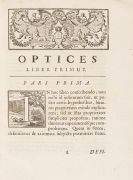
In 1687 Isaac Newton published his book "Principia", which included his famous three laws of motion and his universal law of gravitation on the interdependence of gravity and mass. After he had been a Member of Parliament for the University of Cambridge from 1689 to 1690, he suffered a severe nervous breakdown in 1693, which interrupted his scientific work for a long time.
In 1696 Isaac Newton became Warden of the Royal Mint and three years later Master of the Mint. In 1700 Newton left Cambridge and moved to London, where he became president of the Royal Society in 1703 and in 1705 the first scientist ever to be knighted.
Isaac Newton died on March 31, 1727 in London aged 84.

Would you like to sell a work by Isaac Newton?
Infos for seller


Starting bid: 1,500 EUR